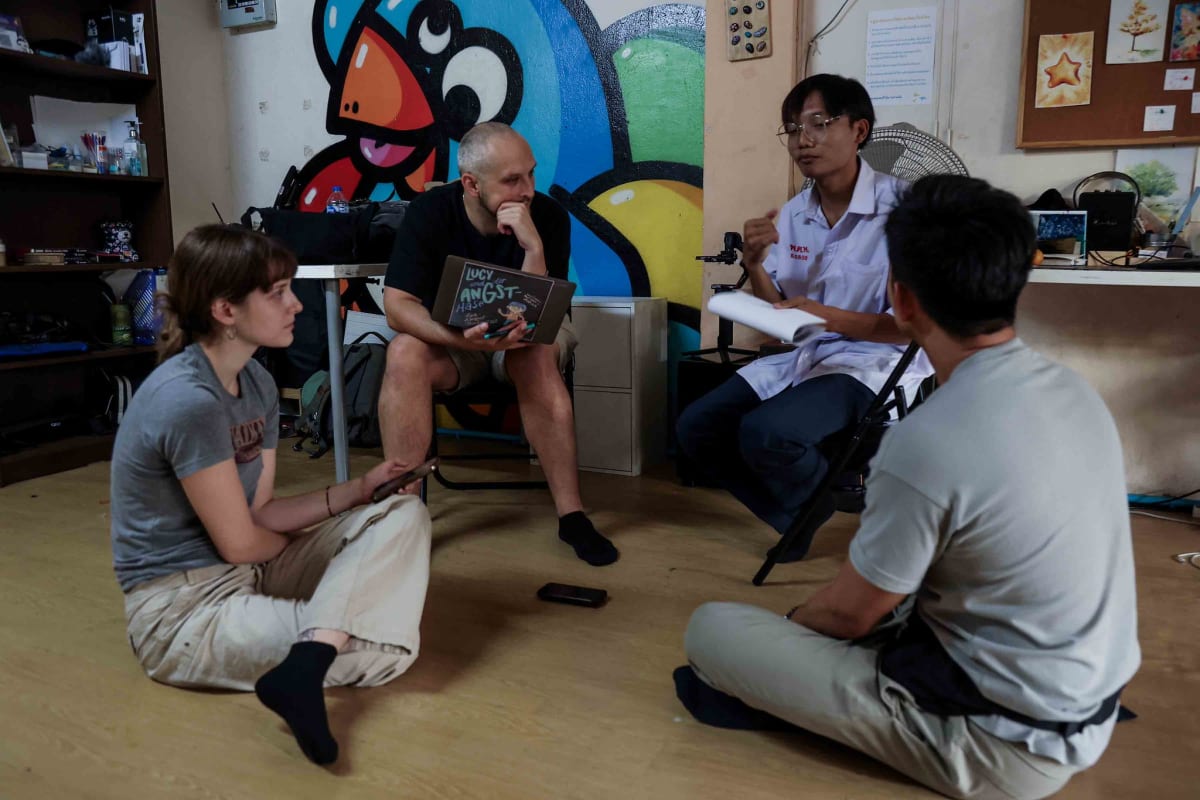
Someone is always ready to tell you about a problem worth filming.
A sugar cane field in Nicaragua where workers are dying of kidney disease. A trafficking route through eastern Asia. A neighborhood in your own city where people are going hungry every night. These are real. They are devastating. They are issues worth global attention. And someone will tell you, urgently and sincerely, that you need to make a film about it.
They are not wrong that the problem exists. They are wrong about what that means for you as a filmmaker.
Here is the distinction that took me years of documentary work to be able to say clearly: a problem is not a story. A solution is a story. And if you build your documentary practice around finding solutions rather than documenting problems, you will make better films, find better subjects, and spend your career doing work you actually believe in.
What’s Wrong With the World Is Not Your Story
Early in my work with Actuality Abroad, I filmed with a man in Central America who had built a real reputation for establishing agricultural cooperatives. Eventually I came to call him a friend.
He once told me about a village leader who had come to him for advice on forming a cooperative of their own. The village’s income source: a local adoption agency was paying families $1,000 USD per infant and “selling” those infants to foreign adopters for around $10,000. The village leader wanted to cut out the middleman.
It is real, and it is devastating. I considered it. I looked into it and researched it. But because there was nobody working to shift or stop the problem, I could not find the story in it without inserting myself into the world and the narrative in ways that were not possible, not safe, or not honest. I had to pass.
What we can do to right the wrongs in this world simply inspires me more than talking about what is wrong with the world. That is not a moral position. It is a filmmaking position. It determines what kind of stories I tell, and who I tell them with.
The Protagonist of a Social Purpose Documentary
Every documentary needs a protagonist. In social purpose filmmaking, that person is not the filmmaker. They are the person actively working to solve something.
A changemaker organization can drive the work, fund the mission, and measure the impact. But an organization cannot be a protagonist. A protagonist has to be a person, and a good protagonist is both inspiring and relatable. They have a story worth telling, a story with a beginning, a middle, and an end. And they are looking to enact permanent, positive change in their story.
The distinction matters in practice. A good changemaker organization does impactful work and has the metrics to prove it. A good protagonist works within the world of that changemaker and has a human story you can follow. Those are two different things, and you need both. The organization gives your film its context and its stakes. The protagonist gives your audience someone to care about and to cheer for.
When you approach documentary work as problem-first, you often end up with a film that catalogs suffering and leaves the audience with nowhere to go. When you approach it as solution-first, you are already embedded in a story with a protagonist, a goal, and a destination.
That structure is not an accident of good filmmaking. It is a direct result of who you choose to film with before you ever pick up a camera.
The Practical Consequence of This Distinction
The solution-first approach is not only a philosophical argument. It changes what you actually do when you sit down to look for a subject.
When you ask “what problem should I film?” you are scanning the news, the advocacy reports, the headlines. You are looking at the worst of things. This is useful background, because you will need to understand the world your eventual collaborator operates in, but it is the wrong starting question for finding a story.
When you ask “who is trying to solve this?” the search looks completely different.
You are looking for people in motion. You find them in local media, written by the reporter who covers nonprofits and small organizations that rarely get attention. You find them on bulletin boards in cooperative grocery stores and community centers. You find them at the front desk of a hostel in a city you are planning to film in, where someone can tell you which local organization is doing real work. You find them in Reddit threads in city subreddits, where someone’s offhand comment leads to something extraordinary.
I posted in a Uganda subreddit once, looking for suggestions for potential documentary subjects. Someone responded in the thread and we moved to a direct conversation from there. It was the director of a nonprofit that uses bicycle-drawn gurneys to transport people in inaccessible areas to medical care facilities. The solution they had invented was strange and specific and deeply human. It was a good story.
You are not going to find that kind of subject by searching for suffering. You find it by looking for ingenuity.
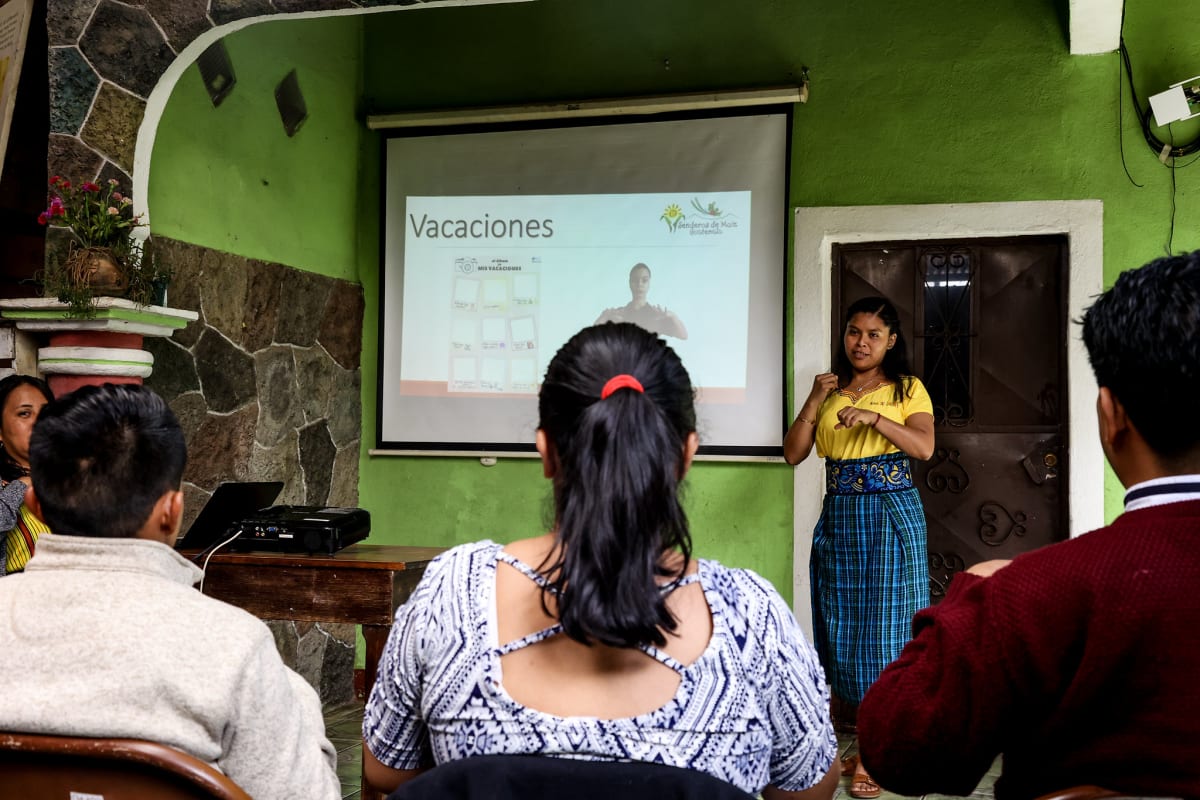
An after-hours sign language class at Alma de Colores, a restaurant staffed by deaf people, Guatemala. Actuality Abroad Documentary Outreach, 2023.
What to Look For Once You’re Looking in the Right Direction
Once you reframe the search, you still have to filter. Not every organization doing good work is a good documentary subject. A few things I look for early in research:
They can tell you what success looks like. This is a question I ask every potential collaborator: What does success look like for your organization? The answer matters more than almost anything else in initial evaluation. If they can give you metrics — enrollment figures, water access rates, farms reached, families housed — then you can build a story around a trajectory. If the best they can say is “well, look at all the people we’re helping,” you are going to spend your entire production struggling to get that idea across to an audience. Goodwill alone is not a good story.
The story gives the audience closure. Changemakers love to talk about the next project, the funding they are close to securing, the program planned for next spring. That is not what you want to film. A good documentary subject is one where the story already has some resolution available to you: a project far enough along to show results, graduates, or some other form of fruition, or a story recently enough resolved that you can piece together its beginning, middle, and end and relate it to an audience honestly. You are looking for a story that gives the audience closure.
You find the work genuinely interesting. This one gets underweighted by newer filmmakers who assume passion follows the camera. It does not, not reliably. You will be embedded in the world of whoever you film with. You will read their history, attend their events, ask strangers to talk on camera about what this person’s work means to them. If you chose the subject because the cause seemed important rather than because it genuinely interested you, that will show up in the film.
Start with what already interests you. The research happens inside that territory, not before you have defined it.
The Question Behind the Question
There is a version of the problem-versus-solution distinction that goes deeper than filmmaking strategy.
When I began my work taking student crews to film alongside grassroots organizations in communities around the world, I had to decide what kind of filmmaker I was going to be. Not stylistically. Ethically.
There is documentary work that exposes. It follows the problem, documents the suffering, and trusts that an audience who sees something will do something. That work has value. I do not dismiss it.
The repeated immersion in what is broken, with no stake in what might be fixed, takes something from you eventually. But it carries a weight beyond the personal. It takes something from the people on the other side of the camera too, people who often agreed to be filmed in their worst circumstances and received, in return, an audience’s shock, and very little else.
The changemaker approach is different. You are embedded in a community that is already working on something. You are not arriving to document damage. You are arriving to tell the story of someone fighting back. That changes what the camera records, what the people in front of it feel about being filmed, and what the audience leaves with when the film is over.
Most people who watch a well-made social purpose documentary leave wanting to accomplish something. That is the power of a story built around human agency, around someone who saw a problem and decided to move toward it rather than away from it. An audience responds to that because they recognize it as the truest possible account of how change actually happens.
Don’t look for what’s broken. Look for who is fixing it. Your film lives in that gap.

A street market in Ho Chi Minh City, Vietnam. Actuality Abroad Documentary Outreach, 2026.
This post draws on ideas developed in Purpose-Driven Documentaries (Routledge), a field guide to social impact filmmaking. Find it on Amazon.
Want to go deeper on documentary storytelling? Listen to “Creating Impactful Documentaries with Robin Canfield” on the Serpositivity podcast.
Learn more about Actuality Abroad documentary programs.