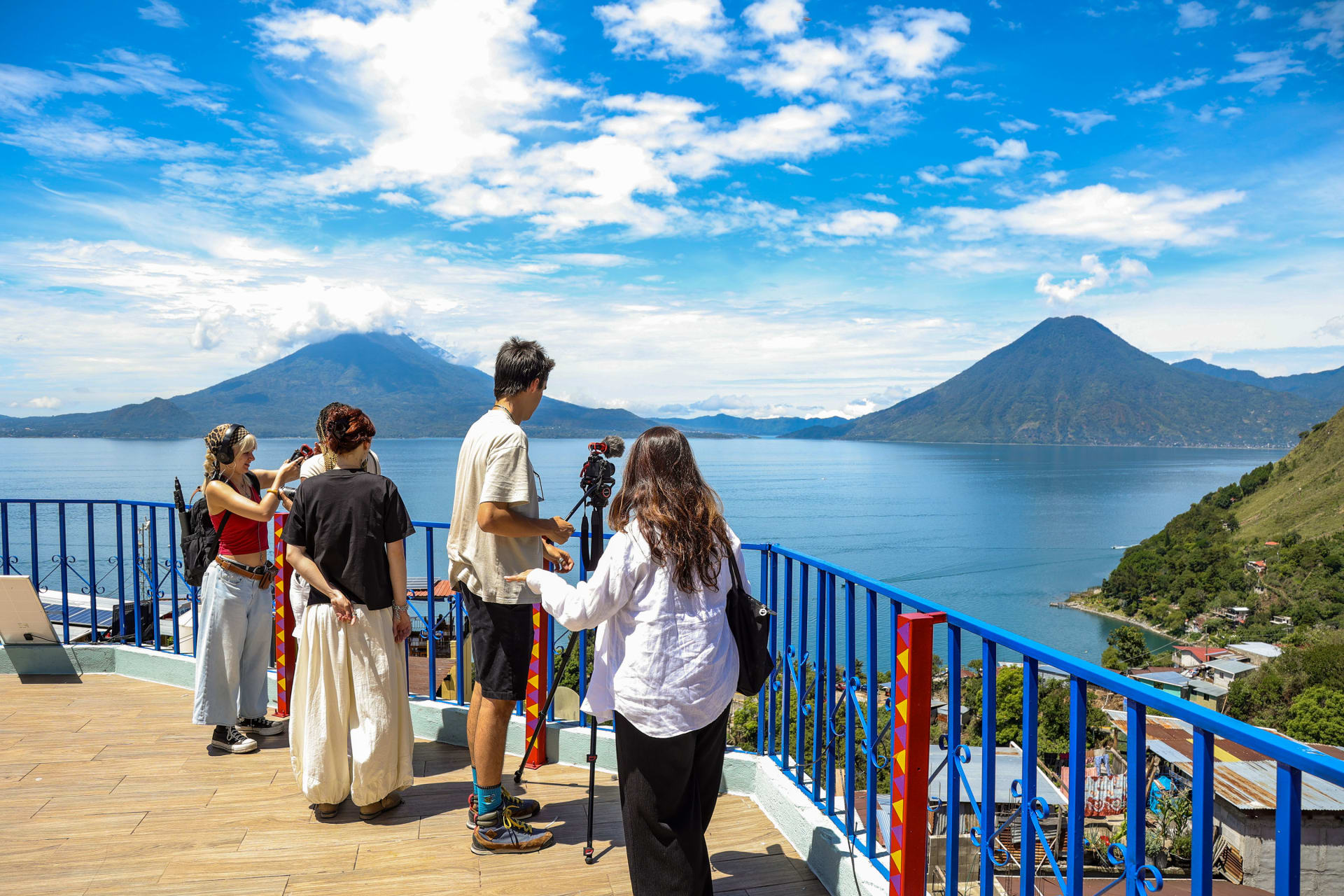
It took years of conversations to get a film crew inside Amigos de Santa Cruz. The organization is a lifeline for its village above Lake Atitlán, and it was camera shy about telling that story to the world. In July 2026 we finally had the project on our docket. We never would have guessed the turns it would take. Four weeks later the crew had finished Vámonos a Marte, a film about a young teacher named Ricardo.
One crew, two cinematographers
Shifts in the roster before travel left enough people for two small crews. We decided to build one bigger crew instead. Every role was covered, and for the first time ever, two official cinematographers worked on the same crew.
- Producer: Neharika Dembla
- Director: Valentina Sommadossi
- Cinematographers: Zara Hodgson and AJ Taylor
- Audiographer: Lexi Treece
- Editor: Robin Canfield
Robin was also the Field Producer. He ran the daily briefings straight out of his book, Purpose-Driven Documentaries, guided the crew through research and production, and edited the film himself.
“I really enjoyed the structure of this program. Very immersive and informative, and the great company helped! I had a great time and feel as though I learned skills that will benefit me as I go forward with film-making.”
Lexi Treece
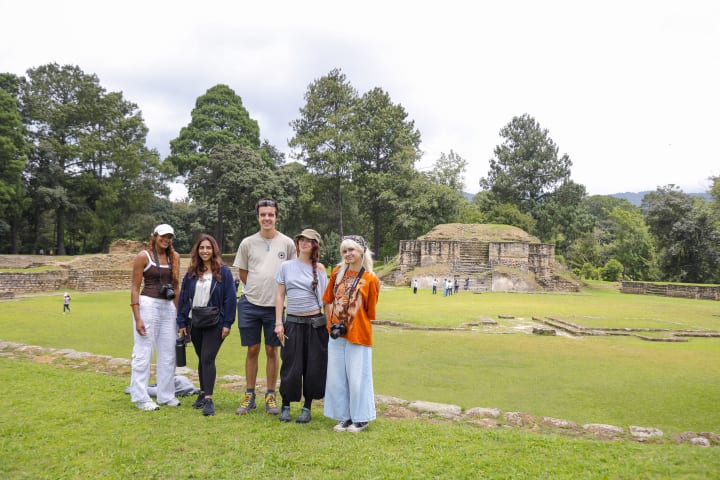
Left to right: Zara, Neharika, AJ, Valentina, Lexi. On the first weekend in-country, the crew visited the Maya archaeological site of Iximché.
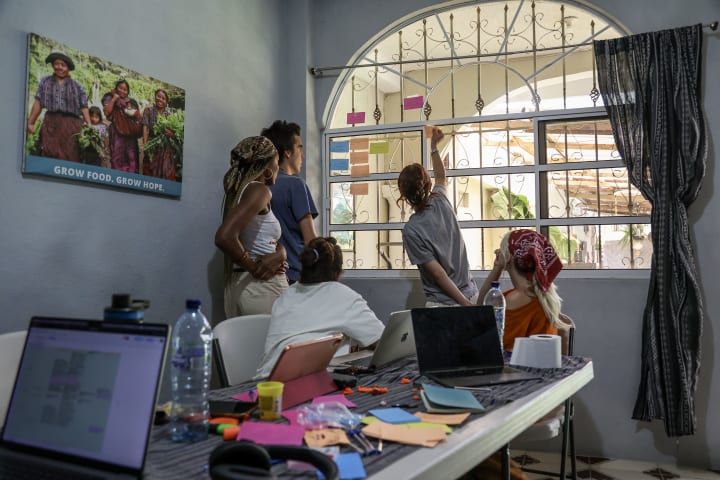
The crew of Vámonos a Marte gathers around their paper cut in the BaseCamp office, adjusting the flow of the story.
Crossing the lake every day
Under high-altitude sun, the crew crossed Lake Atitlán every day on lanchas, the boat taxis that run between Panajachel and Santa Cruz la Laguna. Panajachel is the bustling tourist town. Santa Cruz is smaller, quieter, and shyer with foreigners. The crew took its time there to learn the local culture and get to know people.
In Panajachel, the crew stayed at Hotel Posada Gutierrez. Mr. Gutierrez was on site most days and lives in the neighborhood. He and his staff kept an eye on everyone: helping them find what they needed in town, pointing them to the pool in the courtyard, serving breakfast on the fourth-floor rooftop with a view of the city and the lake. Editing happened in our BaseCamp office.
Aerial view of Santa Cruz la Laguna, filmed by Robin Canfield.
Actuality Abroad has filmed in villages around the lake for years, including Panajachel. Santa Cruz la Laguna is more isolated. Every resource the village doesn't grow arrives by boat or on foot. A generation ago, the water taxis ran weekly, not hourly. Daily visitors from outside are still new there.
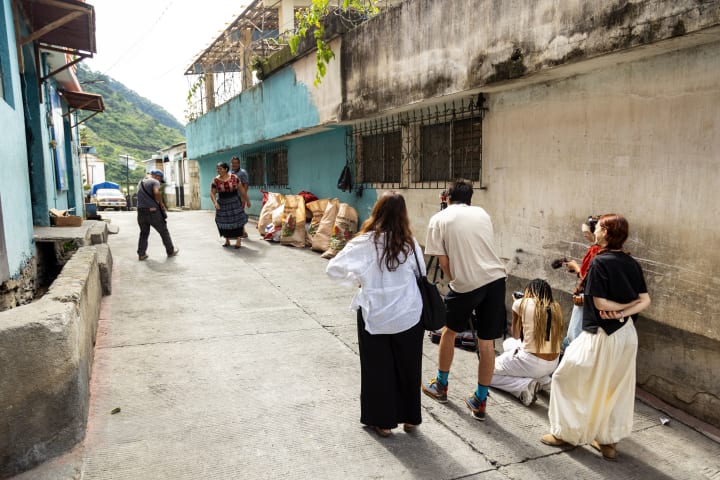
On the streets of Santa Cruz, the crew filmed people and murals, looking for the feel of the village to carry into the film.
Amigos de Santa Cruz, and a school with two grades
Amigos de Santa Cruz runs a woodworking shop, a restaurant that trains people to cook and run a business, a textile incubator, and a computer lab. A scholarship program sends local youth outside the village for further education. The adult education classes are well attended and have spawned small businesses around town. You can also find them on Instagram.
With that many programs, the crew didn't know at the outset where to point the camera. They ended up at one of the newest, Colegio Siqajan, a primary school Amigos is building in Santa Cruz. It has two grades so far and a new building in the works. What it needs now is help reaching families outside Amigos' existing programs, so more children enroll.
The film follows Ricardo, a young man who grew up in Santa Cruz. Amigos gave him a scholarship to study education at university, and he works as an assistant teacher at Colegio Siqajan. His brother is in a different Amigos program. The crew chose Ricardo for three reasons. Villagers could relate to him. He was already a success story for the organization. And he was helping grow a new project out of his wish to see the community improve for the next generation.

With a cinematographer observing from the back during Research Week, Ricardo talks with students in the class where he is an assistant teacher at Colegio Siqajan.
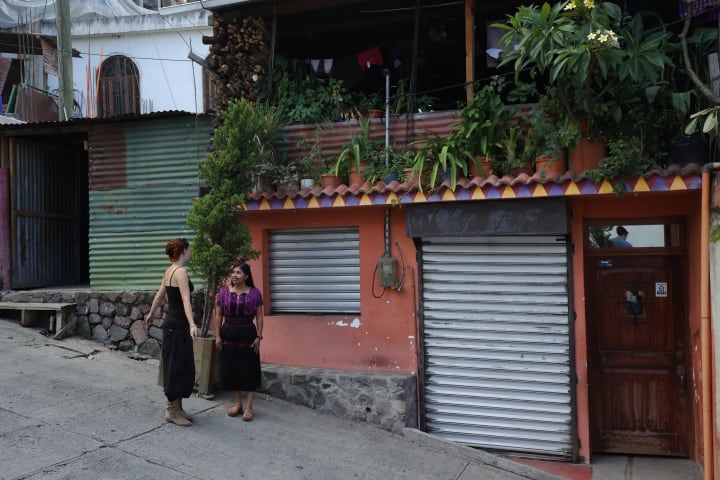
The director, Valentina, talks with Lisa, another person in the film, before Lisa walks toward a home where the crew will join her to film.

Lexi records the sounds of kids at play in the Plaza Central of Santa Cruz.
A film made inside a school
We have worked with children before, always with appropriate consent. This time the kids in the classrooms were a main part of the story, and the whole trip was embedded in a school.
Every Documentary Outreach closes with a screening, a farewell gathering where the crew watches the new film with the people who helped make it. Usually it's a dress-up, Friday night affair. The kids wanted to see the film, so we flipped the schedule and screened on Friday morning. Twelve hours doesn't sound like much in a four-week project. Those were editing hours. The crew made them up with a very late night of final touches.
The protagonist nobody planned on
Week One is research and relationship building. The crew met daily with Amigos staff, volunteers, and the people its programs serve, and quickly learned how the organization works. Then they started asking people to be the central protagonist. Everyone had been told this was coming before they met the crew. Still, the leaders of Amigos didn't want to be at the center of the film.
The crew met several women they would have gladly featured, partly because women are underrepresented in local media. The women were too nervous to carry even a short film. Then there was Ricardo. The crew had met him early and thought of him as a secondary character. When they sat down with him again and heard more of his story, they realized he was the protagonist.
Losing a story is disappointing. It's never the end. We prep crews not to avoid problems but to solve them when they show up. Informed consent is part of finding a protagonist, and sometimes it asks too much of a person. Because this crew knew what kind of story it wanted, it kept searching until it found the right person, even though that meant passing up other good stories.
Two cameras, one plan next time
Two cinematographers on set at all times was an interesting experiment. It also created problems. Each was assigned A Cam or B Cam on different days, and they didn't always defer to the A Cam. Put simply, there are several unused clips with cameos by crew members.
Next time we'll stick to a single camera plan. A crew can still bring a second camera if it has the gear and a plan, or borrow a camera operator from another crew on the Outreach when one is free.

The crew interviews the woodworking instructor at Amigos de Santa Cruz and finds two cameras hard to fit in a tight space.
Watch Vámonos a Marte
Ricardo, a young musician in Santa Cruz la Laguna, studies to become a teacher at a new elementary school so he can provide for himself and his community.
The community screening happened in the morning at Colegio Siqajan, so Ricardo and the students featured in the film could attend.
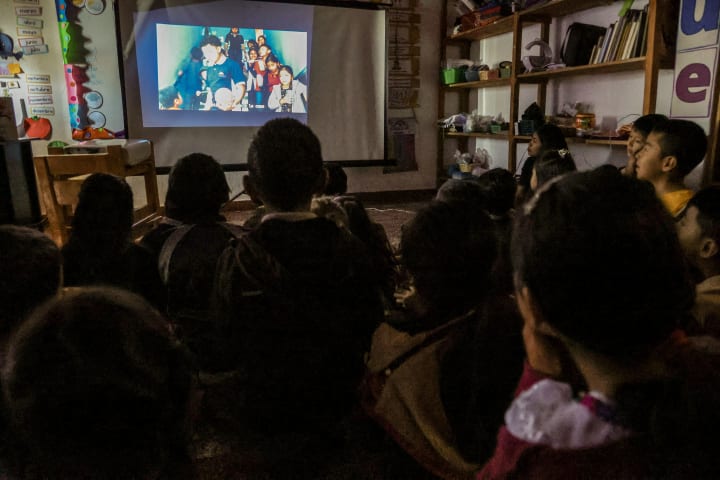
The official in-country screening, in a classroom at Colegio Siqajan with students gathered to watch the film.
Film: Vámonos a Marte
Credits
- Producer: Neharika Dembla
- Director: Valentina Sommadossi
- Cinematographers: Zara Hodgson, AJ Taylor
- Sound Engineer: Lexi Treece
- Editor + Drone Pilot: Robin Canfield
To see our upcoming programs, and to help us decide where the next Documentary Outreach goes, vote on our 2028 locations.