There is an ethical consideration in documentary filmmaking that does not get nearly enough attention, and it is this: you do not have to make a single bad editorial decision to cause harm with your film.
The harm can begin before you press record. It can begin the moment a community learns you are there.
Most conversations about documentary ethics focus on what ends up on screen: what you choose to include, what you leave out, whether you have consent, whether you have told the truth. Those questions matter enormously. But they all assume the damage, if there is any, happens in the edit suite or at the moment of release. In practice, the presence of a film crew can set things in motion that the filmmaker never intended and may not even know about until the situation has already become complicated.
On multiple occasions I have seen small changemaker organizations have unspoken or long-standing internal disagreements rise to the surface when a film crew arrives to tell their story. The crew or the camera becomes a kind of catalyst, and some things that had been quietly held in check start to move. I have never forgotten hearing the filmmakers behind Free Solo discuss their fear that pointing their camera at Alex Honnold was enough to make him take risks on the rock face he would not have taken on his own. The stakes there were of a different order, but the principle is the same: presence changes things.
This is not a reason to leave the camera at home. It is a reason to think more carefully about what you are walking into, and what your arrival might mean to the people already living there.
The Festival That Grew Too Large
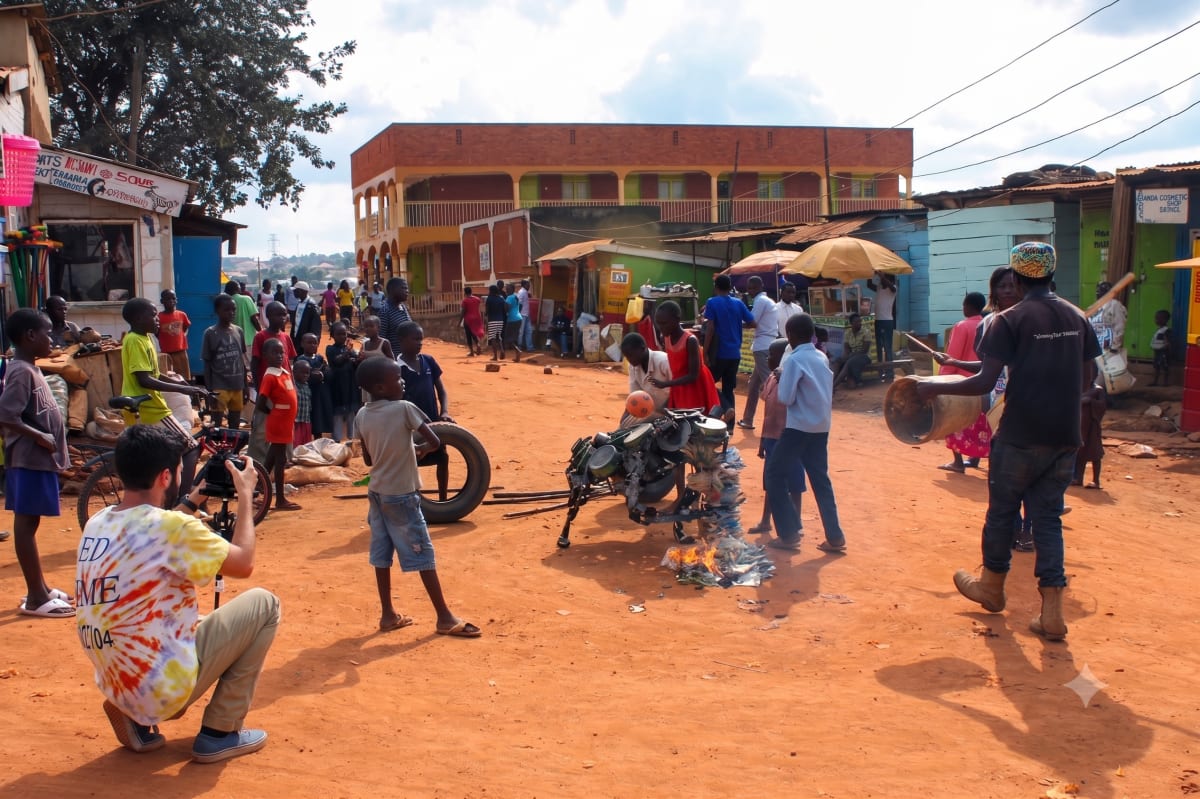
In Kampala, Uganda, an Actuality Abroad crew worked with Reagan Kandole, a young eco-artist who has made it his personal mission to create art from the trash and waste accumulating in his community rather than leaving it to sit. He transforms plastic waste into sculpture, places the work in public spaces around Kampala, and has spent years building ECOaction into a genuine force for environmental education and livelihood creation in one of the city's most underserved neighborhoods. He is still doing that work today, and we are still in good standing.
One of his ideas, which came up during our pre-production conversations, was to organize a community festival. It was the kind of event that fit naturally with who he was and what he did. If it happened while we were there, it would have been the first time it had ever taken place, but it was not an unreasonable idea for him to have.
As the dates of the project got closer, though, the festival grew. It expanded in his mind with each conversation, and then he started asking us to fund different aspects of it.
We had to stop and look honestly at what was happening. A grand community festival was not something Reagan could pull off at that point in ECOaction's existence without our involvement. Our presence, our cameras, and our arrival as an audience had inflated something that would not have existed in that form without us. We had crossed into territory where we were no longer documenting what was there. We were creating something new, then planning to film it as if it had always been there.
That is not documentary. And whatever the result would have been, it would not have been honest.
We stepped back from the festival, and the documentary project with Reagan. It was the right call, and it was a harder conversation than it should have been, because by that point Reagan was genuinely excited about an event he now expected to happen. We did still make a short film with him during that program, “Waste Management Education Project,” and we are still on good terms. But the damage from the festival conversation was real, to a relationship and to the expectations of someone who had trusted us.
A filmmaker documents ECOaction's work in a Kampala neighborhood. Uganda, 2015.
The Cooperatives That Weren't Asked
San Juan la Laguna sits on the shore of Lake Atitlán in the Guatemalan Highlands. The town is home to numerous small textile cooperatives, each run by women from the local Tz’utujil Maya community. To tell a story that honestly represented what those cooperatives meant to the town, a crew working with Actuality Abroad focused their documentary on Rosalinda “Rosa” Tay, who leads Asociación Lema’, a weaving cooperative she founded in 1999 to preserve traditional dyeing and weaving techniques and help women in her community earn income. For the rest of the film, they called her Rosa.
The research process was thorough. Rosa understood what the project was, where the film would go, and what the potential outcomes were. The crew had done what they were supposed to do.
What none of them had thought through was what would happen in the weeks between the start of research and the end of production, as word spread through a small, closely connected town that one cooperative was being filmed and the others were not.
Women who were Rosa's friends and neighbors started to feel overlooked. The social dynamics of a tight community began to shift around a project that had nothing to do with those dynamics when it started. The crew was suddenly navigating a situation with real stakes: Rosa's relationships with people she had known for years, and the real possibility that she would withdraw from the project entirely to protect those relationships.
The crew met. They talked it through. They revised their story outline, added to their shot list, and spent a day visiting other cooperatives around the town. The finished film, Poco a Poco, is still primarily Rosa's story. But other cooperatives in San Juan appear in it, and are recognized with their name on screen. The community is present, not just the protagonist.
It was a better film for it. And the problem it solved was one the crew had not thought to anticipate, because they had been thinking about the film and not about what their presence would mean to the people watching them work.
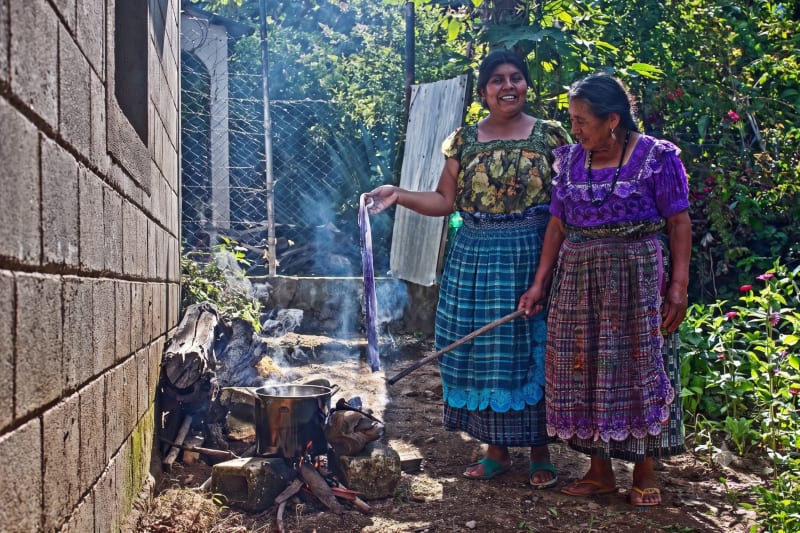
Members of Asociación Lema’ prepare natural dyes using traditional techniques. San Juan la Laguna, Guatemala, 2013.
What a Camera Signals to a Room
These are not isolated incidents. Once you start looking for this dynamic, you find it regularly.
In Morocco, a crew encountered two feuding neighbors, and the camera exacerbated it. The crew had not created the feud. They had not encouraged it. But the camera was there, and the camera was an audience, and the audience changed what people were willing to do. What began as frustration and anger escalated to police reports, and even false claims that the crew needed a special permit to film inside one of the neighbor's buildings, when no such permit existed.
These situations are not always so dramatic. Sometimes it is as quiet as a community assuming your crew has money, because in their experience people with cameras have money, and then watching to see whether that assumption gets confirmed. Sometimes it is an organization's staff performing a version of their work that they believe is more filmable, rather than doing what they would normally do. Sometimes it is a subject who becomes subtly more careful, more polished, less candid, because they have had time to think about the fact that you are going to share what you film with an audience they cannot see.
An organization that knows a documentary is being made about them may make different decisions about what to do, what to say, and what to prioritize while you are there. Every one of these shifts is a change to the story you came to tell. And most of them happen not because of anything in the footage, but because of what your arrival communicated.
The Question to Ask Before You Arrive
There is no formula for predicting exactly what a crew's presence will set in motion. Communities are too varied, people are too individual, circumstances are too specific. But there are questions worth sitting with before production begins.
What does the community around your subject know about the project, and what might they assume from what they know? In a small town or a tight-knit neighborhood, word moves quickly, and it rarely moves with full accuracy. People will fill in what they do not know.
Who might feel excluded by the focus of your story, and what might that exclusion cost them in the community they live in? Rosa's situation was not unique. Any time you center one person or one organization within a community that has relationships and history, other people in that community are implicitly being de-centered. That has social consequences that have nothing to do with your film.
Does your presence change what is possible for your subject in terms of funding, attention, or ambition? Reagan's situation is the clearest example of this, but it surfaces in subtler ways all the time.
And perhaps most importantly: have you discussed with your collaborator not just the film you want to make, but what the experience of being filmed might mean for their community while it is happening? This conversation is part of ethical production, not a preliminary to it.
The Responsibility That Starts Before the Camera Does
The principle of doing no harm to vulnerable people in documentary is usually framed around editorial decisions: what you include, what you release, what you choose to put in front of an audience. That framing is correct and necessary. But it is not complete.
The filmmaker's responsibility begins earlier. It begins when people start to know you are coming, when the community starts forming expectations, when your subject begins adjusting to the reality of being filmed. By the time you arrive with a camera, things are already in motion.
With Rosa's situation and the situation with Reagan's festival, both crews found their way through, and both films were better for having navigated the complications honestly. But they found their way through because the crew members were paying attention to more than the footage. They were paying attention to the people.
The camera records what is in front of it. The filmmaker is responsible for what they set in motion to get there.
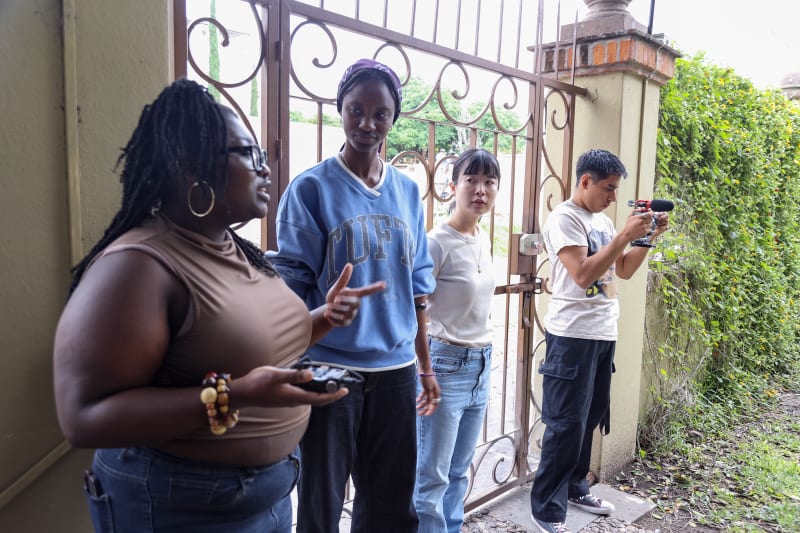
An Actuality Abroad crew prepares to film outside a community space. Mexico, 2025.
This post draws on ideas developed in Purpose-Driven Documentaries (Routledge), a field guide to social impact filmmaking.
For more on documentary craft, listen to “Robin Canfield on Teaching iPhone Documentary in 20 Countries” on the Documentary First podcast.
Related read: Your Documentary Doesn’t Start With a Problem. It Starts With a Solution.