
The crew was set up outside a woman's house in Cartagena, Colombia. They were filming with Granitos de Paz, an organization working with internally displaced communities on the outskirts of the city, where marshland was slowly becoming housing with a very vague legal status. The woman they were interviewing had a backyard garden connected to the organization's program, and a daughter involved in their youth projects.
The interview was fine. They got what they came for. When it came time to cut the footage, though, the crew felt like something was missing. So they went back and watched the tape.
One of the more stakes-driven questions had been about what Granitos de Paz was helping the woman achieve for her family. She answered thoroughly. She talked about income from the garden, about the youth programs bringing opportunities for her daughter. And then she paused.
On set the Cinematographer, thinking the answer was finished, started talking about reframing for the next question. He made a joke. The crew laughed.
And somewhere underneath the laughter, the woman said the thing she had been working up to.
“But what I really want to do is open a candy store.”
It was the perfect line. One sentence that would have told the audience everything about who this woman was beyond her circumstances, beyond the program, beyond the story the crew was trying to tell. It would have made the audience love her.
It was completely unusable. This was long enough ago that an AI audio fix didn't even exist yet, and even if it had, the crew's voices were all over it. That soundbite was gone.

An Actuality Abroad crew interviews a community member working with Granitos de Paz. Cartagena, Colombia, 2011.
What Silence Actually Does in an Interview
Most first-time interviewers treat silence as a problem to solve. There is a pause after an answer. The instinct is to fill it with the next question, with affirmation, with anything. It feels like dead air. On both sides of the camera it feels like something went wrong.
What is actually happening in that pause is often the most productive moment of the interview.
The interviewee has just finished what they planned to say. They gave you the answer they prepared and mentally verified. And now the question is still hanging in the air, with nothing going forward. The interviewee is left alone with their own thoughts about what they just said. That is when the real answer comes forward. The unguarded one. The one that did not get workshopped before the camera arrived.
Silence in a conversation is uncomfortable. Almost everyone fills it eventually. And what a person says to fill silence they did not expect is almost always more honest, more specific, and more human than what they said before it.
The candy store was her true answer. It took the woman's story from a narrative about a program helping a family survive and made it a story about a person with a dream. Those are not the same story. The second one is better. The crew didn't get to tell it.
Why Interviewers Talk Too Soon
There are a few reasons interviewers break silence before they should, and most of them are understandable.
The first is nerves. Conducting an interview feels like a performance, especially early on, and silence reads as failure when you are performing. If nobody is talking, the thinking goes, something must have gone wrong.
The second is preparation. You have a list of questions. You know what soundbites you need. When someone finishes an answer, the temptation is to check the box and move to the next one. Efficiency feels like professionalism.
The third is comfort with the interviewee. The crew in Cartagena had spent time with this woman. They liked her. The Cinematographer made a joke because it felt natural, because the atmosphere was relaxed. None of that is a mistake on its own. The mistake was making the joke too soon.
All three of these instincts are working against you in the same direction: toward filling the silence before the interviewee has said all they have to say.
How Long Is Long Enough
There is no fixed number of seconds. Sometimes you even have to speak up simply because the interviewee is talking for way too long. What you are waiting for is not a countdown. You are waiting for the interviewee to decide they are done, not for you to decide for them.
In practice, that means holding through at least one moment where you think they might be finished. Not two or three. Just one. If they were done, nothing will happen. If they were not done, you will get the candy store.
What helps is keeping yourself present during that pause. Nodding slowly. Holding eye contact. Letting your expression signal that you are still listening and waiting. Make them feel that there is no rush, that whatever comes next will be welcome. This is not performance. It is invitation. The interviewee is watching you during their pause the same way they have been watching you throughout the interview, looking for signals about whether they are doing well. If your face closes down, they close down. If your face stays curious, they have reason to keep going.
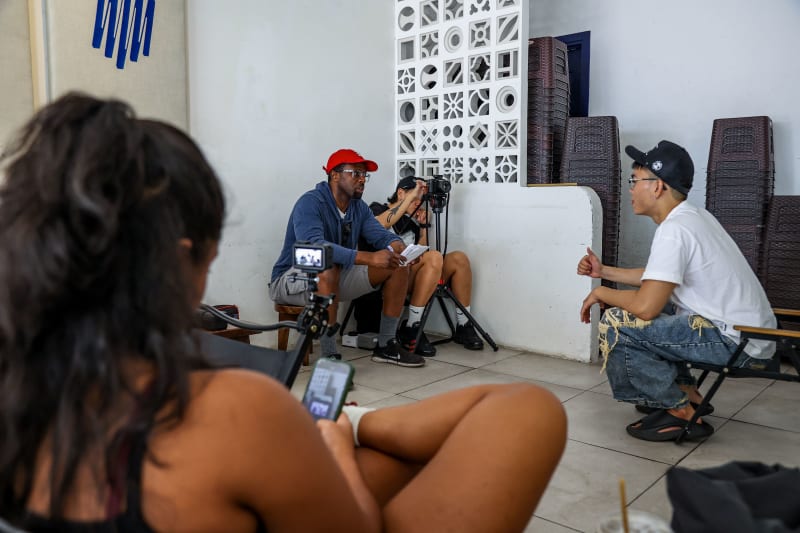
Crew listen as the founder of Dope Cafe explains why he started the business. Ho Chi Minh City, Vietnam, 2026.
When Silence Becomes a Tactic
Beyond simply waiting for an answer to finish, silence can be used deliberately when you are not getting the answer you need.
Ask a question. Receive an answer that is incomplete, evasive, or different from what the interviewee told you during a pre-interview. Do not ask a follow-up question immediately. Do not smile and nod and move on. Say nothing. Hold the space.
The interviewee gave what they thought was a sufficient answer. The silence tells them otherwise, without accusation, without confrontation. In the gap between their answer and your next question, they will often begin to elaborate, correct, or reveal what they were holding back.
This works because of the same social pressure that makes silence uncomfortable in the first place. A person who has just answered a question in a surprising way and is met with nothing has to make a decision: sit in the silence, or explain. Most people start talking again.
There are limits to this. Used too often in a single interview it becomes strange, and the interviewee will start to notice the pattern. Used at the right moments, with the right person, it is one of the most powerful tools an interviewer has. It costs nothing. It requires no follow-up question. It simply requires you to resist the impulse to speak.
What to Tell Your Crew Before You Start
The candy store answer was lost not because the interviewer broke the silence. It was lost because someone else on the crew did. This was a preparation problem, and it is entirely preventable.
Before any interview begins, every person on an Actuality Abroad crew needs to understand one rule: nobody speaks until the Director signals that the take is over. Not to adjust the frame. Not to check a level. Not to make a joke, no matter how relaxed the atmosphere feels. The one exception is the Audiographer, who must speak up if a sound disruption has made an answer unusable; clean audio takes priority over maintaining silence. In every other case, the interview is not over until the Director says it is over, and the Director should not say it is over until several seconds after the last word the interviewee speaks.
The best crews run on nonverbal communication during an interview. The Cinematographer signals to the Director when they want to change the frame. The Director signals back when it is safe to do so. The Audiographer raises a hand if there is a sound issue. Nobody talks. The interviewee never gets the impression that anything has finished when it has not.
The Minute You Cannot Plan For
One of the harder things to accept about documentary interviews is that the best moment may arrive at any point, and you cannot know in advance when that will be.
In a thirty-minute interview, the line you end up using in the film might not come until the twenty-sixth minute. You had to sit through the first twenty-five to get there. There is no shortcut. Some interviewees, particularly people in leadership who have been asked about their work many times before, will talk their way through an entire prepared speech before they get to the part where they are actually talking to you. That speech is going to happen whether you try to skip it or not, and trying to skip it will only make them feel dismissed. Let it run. What comes after it, once the practiced version is out of the way, is usually where the real interview begins.
Patience in documentary interviewing is not passive. It is a decision, made over and over throughout the interview, to stay in the moment a little longer than feels comfortable. To not rush to the next question. To let the person in front of you finish in their own time.
The candy store came after a thoughtful silence. The crew just needed to wait for it.
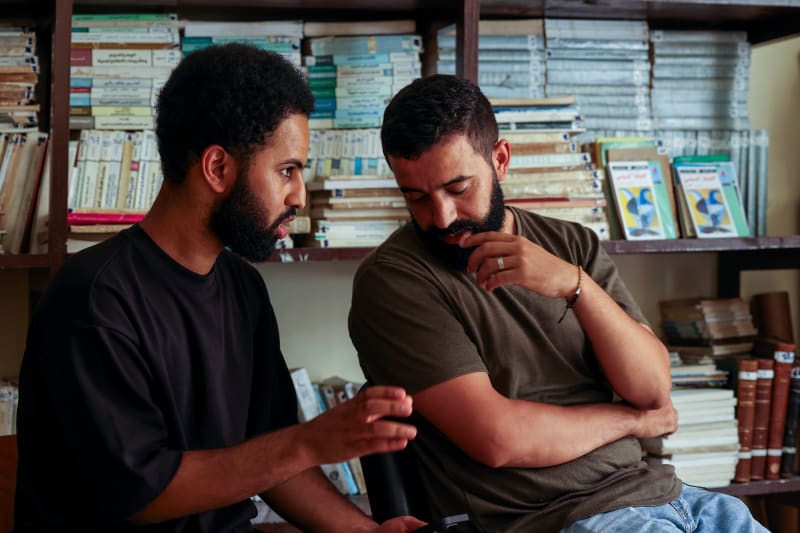
A director chats with an interviewee after the questions are finished. Morocco, 2024.
This post draws on ideas developed in Purpose-Driven Documentaries (Routledge), a field guide to social impact filmmaking.
For more on documentary craft, listen to “EP211 Robin Canfield, Co-Founder and Director of Actuality Abroad” on the TV Matters podcast.
Related read: Your Documentary Doesn’t Start With a Problem. It Starts With a Solution.
Related read: Your Presence Is Already Part of the Story